





TL;DR: Content Marketing is putting “gas in the car” for SEO. Unless you have a nationwide or globally known brand, you simply can’t succeed in SEO without content marketing.
Introduction

I’ve been telling clients for the past 15 years: If you “optimize” your site for SEO, meaning doing technical optimizations, keyword-optimizing meta tags and content, etc., as a one-time effort, you may indeed get an initial lift, but it won’t last. I always say, “It’s like building a powerful racecar and putting its first tank of gas in it. You will go a certain distance on that first tank, but you have to keep refilling it.” Content marketing is the way to do that.
And let’s not forget the humans here. Creating content without understanding who your target audience is and what information they are searching for is a futile exercise.
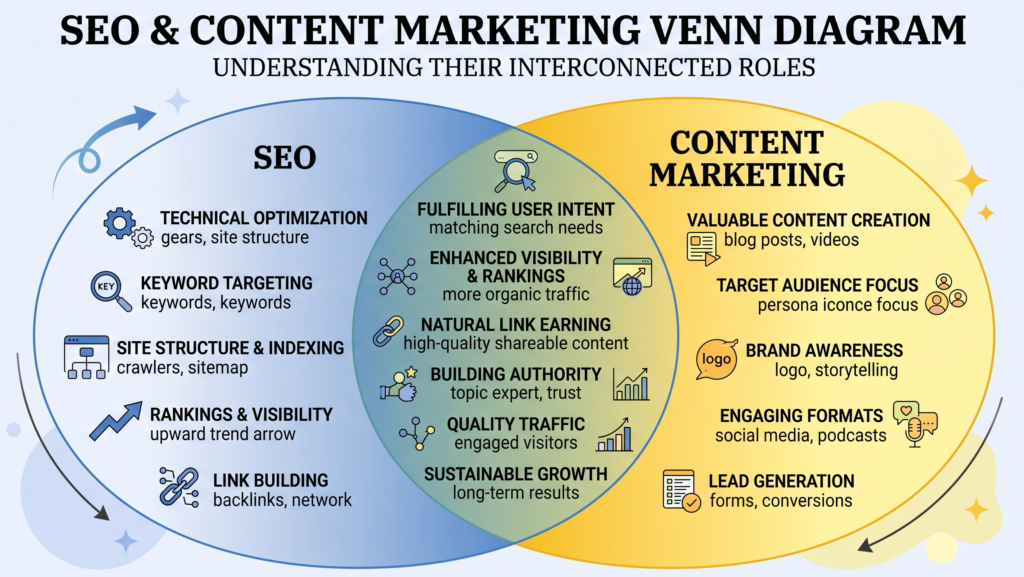
Think of SEO and Content Marketing as a Venn diagram: two intersecting circles that are different, but also overlap and complement each other.
What is Content Marketing?
Content marketing is the act of publishing content, in a variety of formats, to demonstrate your brand’s expertise and authority. The formats can include written articles, social media posts, videos, webinars, case studies, white papers, podcasts, etc. All of those contribute to brand authority.
Although brand authority arguably has become the most important ranking factor in 2026 now that we are in the era of AI-powered search, the form of content marketing most directly related to SEO is written content that is publicly available on your website.
I am often asked if gated assets (content that users have to register to view) is beneficial for SEO, and the short answer is “no.” Anything that isn’t publicly available without registration cannot be viewed, and therefore cannot be indexed, by search engines. The one caveat: if you write a robust amount of high-quality, helpful content on your landing page (the page that contains the registration form), then that page will be able to be indexed and may rank in search engines.
For the rest of this article, I’ll focus on publicly accessible written articles, commonly referred to as “blogs.”
The Benefits of Content Marketing for SEO
1) Content Marketing Captures Top-of-the-Funnel Research
Before people decide to buy something, they research it, and before they research a particular product or service, they research the problem that they are having.
Here’s an example: I was recently shopping for a natural solution to the mosquito problem I have in my yard. I wanted something all-natural as I have dogs and well water, so I don’t like to use chemicals. I searched “get rid of mosquitoes naturally” and found out that natural ingredients like peppermint oil repel mosquitoes. I read an article about the different types of products that can be used to spread the scent of the oil around your yard. In that research, I discovered that “mosquito balls” are a thing. I had no idea, and never would have searched for that in the beginning of my research. After evaluating the different types of products, I decided to go with the mosquito balls, and then searched for “mosquito balls.”
If you’re writing educational articles on your website, you can a) capture website traffic on those higher-funnel research terms like “get rid of mosquitoes naturally,” but you can also b) gently guide users to check out your product (e.g., mosquito balls) via a link in your educational article.
2) Content Marketing Earns Backlinks
On top of the benefit of capturing high funnel traffic, high-quality articles also tend to earn backlinks. A backlink is when another website links to your website. This is very beneficial if done the right way. For more on that, check out our article “Our Approach to Modern-Day Link Building for SEO.”
If you write an article that is a high-quality and helpful educational piece, other sites may link to it. This is especially true if you promote your articles on social media and through public relations efforts.
3) Content Marketing Establishes Thought Leadership
There’s nothing like being able to say to a prospective client, “Oh, I just published an article about that.” You’re immediately establishing yourself as an authority in the field, simply by positioning yourself as an author. But if you write high-quality content, the benefits go even further. High-quality content marketing can be your sales team. It will bring you warm inbound leads without you having to chase leads via outbound sales tactics.
3) Content Can Be Repurposed
One piece of content can be turned into so many different assets! If you craft your content around what your target audience wants to know, then you or your sales team can use that content to answer repetitive questions. I love it when I can answer an email by sending a link to an article I wrote, instead of having to write the explanation out every time someone emails me the question!
Content can, and should, also be repurposed across various media types. A blog article can become a long-form video, which can then become a series of short-form videos; infographics can be created based on an article, or even podcast episodes. And an email newsletter can be built out of rounding up a series of your latest posts.
Sponsored content is another great way to give your content additional mileage. You can share the post on Facebook and then boost it as a paid ad, or run it as Sponsored Content on LinkedIn. This can have an SEO side benefit, too. While paying for content promotion doesn’t directly impact seo performance, there can be a trickle-down effect. The paid eyeballs on the content can lead to more people linking to your content from their website, and that in turn helps seo.
4) Content Is A Long-Term Asset
Creating a piece of content once can serve your brand for years to come. I recently refreshed an article that I originally wrote on my blog in 2011! Fifteen years later, the advice was indeed out-of-date, but the core principles still applied, so I was able to refresh that article instead of writing a new one from scratch. That article gets to keep all of its backlinks, yet my target audience (and search engines) see that my advice is current and relevant to today’s landscape. Now, that article was a straggler, and I definitely do NOT recommend waiting fifteen years to update an article! Refreshing content on a regular basis is more important than ever, so I have now implemented a routine where for each new article I write, I also go back and refresh an existing article at the same time. This helps ensure that I’m always refreshing and not just adding new and burying the old.
Content Marketing Best Practices
Write For Your Target Audience
Don’t start writing content until you’ve spent time working to truly understand your target audience. Focus on understanding their needs, pain points, and the specific questions they ask search engines (and your sales team!). Specifically, be sure to:
- Interview the people at your company who answer the phone.
- Ask them what questions they’re constantly asked.
- Think about why clients come to you.
- What problems are they dealing with that you can solve?
- What have they already tried that didn’t work and perhaps frustrated them?
- What do they think they want versus what you know they need?
- Think about the different types of clients you want.
- What industry are they in?
- What job role do they have?
- Think about their demographics and psychographics.
- How old are they?
- Where do they live?
- What do they truly care about?
- What are they afraid of?
- What are your competitors writing about?
- What target audiences, pain points, etc., are they writing content around? Doing a competitive content marketing audit can give you ideas that perhaps you wouldn’t have thought of yourself.
Once you’ve done this exercise and have painted a comprehensive picture of your target audience personas, you can move on to keyword research.
Keywords Still Matter
Yes, search engines have gotten smarter at knowing what words are synonyms for each other, what different contexts are in a sentence, and that has led some people to declare that keywords don’t matter anymore. But the truth is that it still helps a LOT to give the search engines clear signals through intentional keyword usage, particularly in the article title and in subheadings.
You’ll notice that in this article, I used phrases in the title and subheadings such as:
- Content marketing strategy
- What is content marketing?
- Content marketing best practices
- Benefits of content marketing
This gives the search engines (and my human readers) clarity on what the article covers. Subheadings are great for human readers and SEO because they clearly separate subtopics within the article and avoid the confusing “wall of text” that can occur without them.
How to Find Keywords
When researching keywords, you can use a paid SEO tool like Mangools KWFinder (my personal favorite, and I’m not being paid to say that), or you can simply search different phrases in Google and review the “People Also Search” phrases at the bottom of the page.
Also, pay close attention to the “People Also Ask” questions that often appear in the middle of the search results. Those are GREAT to add to your content to ensure that you’re answering questions that are really being asked in the wild! And in this era of AI-powered search, LLMs like ChatGPT absolutely love content that is in question-answer format, because that’s what people do in AI chatbots, they ask them questions all day long!
Avoid Keyword Stuffing
While it’s important to use your keywords to structure your content, it’s equally important that you don’t over-saturate your content with those keywords. This is called “keyword stuffing” and can harm your SEO ranking rather than help. Search engines value quality content that helps searchers find the information they’re looking for. Therefore, you need to use your keywords naturally throughout all of your content.
Quality Over Quantity
Creating content for the sake of creating content isn’t beneficial to anyone. It won’t impress search engines, and it certainly won’t impress your human target audience. Especially in this era of AI, where the internet is being firehosed with bland, generic, AI-authored content all day, every day, quality matters now more than ever before.
Focus on creating fewer, but longer and higher-quality articles. I’d rather see a client write one high-quality article per month than to establish a weekly cadence where the articles are shorter and “thinner.” Thin content is something Google tells us to avoid. Every URL on your website should provide substantial information to the reader.
Use Your Content as an Opportunity to Shine
Search engines have reached Level 3 sophistication, so regurgitating facts and best practices is not enough anymore. You can’t out-produce AI when it comes to content generation, but you can out-orignate it.
“You can’t out-produce AI when it comes to content generation, but you can out-orignate it.” – Pam Aungst Cronin, 2026
My Level 3 Content Quality Framework identifies three ways that you can “out-originate” the massive tidal wave of hollow AI-generated content that the web is absolutely saturated with at this point. It all comes down to doing what Google tells us to do in their Quality Rater Guidelines: talk about your real-world, first-hand experiences. The experiences that led you to know what you know.
There’s a dual advantage to this. What you’re doing when talking about your real-life experiences is storytelling. Storytelling is incredibly effective in marketing. Humans absolutely love stories. Storytelling should be part of your marketing strategy regardless of your goals, but if SEO is one of your goals, Google is telling us clear as day that this is what you need to do to outrank bland, hollow AI-generated content.
Focus on three types of stories. These particular types of stories highlight the particular type of expertise-gained-through-experience that Google wants you to write about:
Three Types of Stories for Effective Content Marketing
- “Over the Years” Stories: Stories that offer particularly clear signals of lived experience that spanned significant lengths of time. Specifically, these can include:
- Rules of thumb that you’ve established over the course of your career
- The “methods to your madness” and how you developed them over the years
- Long-term effects of decisions that you made or your clients made
- Pivot Points: Stories that talk about points in time where you pivoted either a belief or way of doing things
- The “Only the Pros Would Know” stuff: Stories about the exceptions and edge cases you’ve encountered where textbook theory ran into friction with reality
For more on this, check out the article “How Much AI-Generated Content is Acceptable for SEO Writing?” where I fully go into the Level 3 Content Framework and how it was developed.
Organize Your Expertise
If you have been generating content for some time, you will start to have quite a large catalog of articles. This is a good thing. As I’ve always said, “Google wants your site to be a whole encyclopedia on your topic.”
“Google wants your site to be a whole encyclopedia on your topic.” – Pam Aungst Cronin, 2026
But user experience is equally important. If your human users can’t easily navigate your content, they’ll leave your site.
The Hub and Spoke method is the solution for this, and it serves two purposes: 1) It organizes your content for easy human navigation, and 2) it is good for SEO as it creates topical clusters on your site. Google has said that they are now a “topical match engine” as opposed to the simplistic keyword matching engine that they used to be.
This video describes how the hub-and-spoke method works:
Get Your Content Out There
Over my 15 years running an SEO agency, I have seen this way too many times. Clients invest tons of time creating high-quality content and then never share it! In addition to the repurposing ideas above, also remember to simply share each article that you publish! If you have a WordPress site, there are even some plugins that can automate this for you. Once you post a new article, it automatically gets shared to your social profiles.
B2B vs B2C: Key Differences for Organic Search Strategy
Over the years, I’ve worked with clients across the full spectrum: from e-commerce brands selling consumer products to software companies selling six-figure contracts to enterprise buyers. One of the biggest mistakes I see companies make is applying a one-size-fits-all approach to content marketing for organic search without considering whether they’re selling to businesses or consumers. The fundamentals apply to both, but the best content marketing for B2B looks very different from what works in B2C.
Difference #1: The Length of the Buyer’s Journey
In B2C, you’re often dealing with a single decision-maker who can make a purchase in minutes. Think back to my mosquito ball example from earlier in this article. I researched, decided, and purchased within a couple of hours. No approvals, no procurement department, no committee.
In B2B, you’re typically dealing with a buying committee of 5 to 10 people, each with different concerns and priorities. The sales cycle can stretch from weeks to over a year. This means your organic content marketing strategy has to serve multiple audiences at multiple stages of a much longer journey. Any B2B marketing plan that ignores this reality will be highly unlikely to succeed.
Difference #2: Content Length and Depth Expectations
B2C content can often succeed with shorter, punchier articles. A consumer searching “how to get rid of mosquitoes naturally” wants a clear answer quickly. They don’t want to wade through 3,000 words to figure out what to buy.
B2B audiences, on the other hand, often need and expect longer, more technical content. When a CTO is evaluating enterprise software, they want whitepapers, detailed case studies with measurable ROI data, and in-depth technical documentation. A 500-word blog post is absolutely NOT going to cut it when someone is about to recommend a $200,000 purchase to their board.
Difference #3: Keyword Strategy
B2C keyword research tends to have higher search volumes with broader intent. For example, “Running shoes for women” gets searched tens of thousands of times per month.
B2B organic search keywords are typically lower volume but have much higher intent. A phrase like “automotive seo services” might only be searched a few hundred times per month, but every single one of those searchers could be worth thousands and thousands of dollars in lifetime value.
This is a mental shift I often have to help B2B clients make. They’ll look at a keyword research report and feel discouraged by the low search volumes. I always remind them that in B2B marketing, you are looking for quality traffic rather than quantity.
Difference #4: The Storytelling Angle
Remember the three types of experiential “E” stories I outlined earlier in this article? Those absolutely apply to both B2B and B2C, but they end up looking differently.
In B2C:
- Your “Over the Years” stories might focus on how you’ve refined your product based on customer feedback, or how your understanding of customer preferences has evolved.
- Your “Only the Pros Would Know” content might share insider tips that casual users wouldn’t discover on their own.
- The “Pivot Point” angle here is tougher, but sometimes it’s a fit for talking about your experiences developing your products.
In B2B:
- Your “Pivot Points” stories carry enormous weight. Telling the story of how you realized the industry-standard approach was wrong and what you did differently as a result is incredibly powerful for establishing authority with sophisticated buyers. B2B buyers are often specialists evaluating other specialists, and they can sniff out surface-level content immediately.
- “Over the Years” stories can work here, but need to be leveled up to be less casual and more factual.
- The “Only the Pros Would Know” category needs to be treaded lightly here, too. In B2B, you do need to be careful not to give out your trade secrets, so keep that in mind when trying to develop stories in that category.
Content Formats That Work Best for B2B vs. B2C
For B2C, I typically recommend focusing on:
- Educational articles that solve specific consumer problems
- Product comparison guides
- Gift guides and seasonal roundups
- Hot trends, particularly in the fashion and beauty spaces
For B2B content marketing for organic search, the formats that tend to perform best include:
- Detailed case studies with specific metrics and outcomes
- Expert interviews
- Long-form thought leadership articles
- Industry benchmark data and original research (first-party data)
What Stays the Same
Despite these differences, the core principles of a great organic search content marketing strategy apply equally to both:
- Write for your target audience, not for yourself
- Focus on quality over quantity
- Use storytelling about real, first-hand experience to stand out from AI-generated noise
- Organize your expertise using the hub and spoke method
- Actually promote and distribute what you publish
Whether you’re selling to consumers or to businesses, the brands that win with content marketing are the ones that genuinely help their audience, share authentic expertise, and commit to the long game.
Need Help Developing Your SEO Content Marketing Strategy?
Writer’s block is a real thing. We help our clients know exactly what to write about by doing deep-dive keyword research to see what their target audience is ranking for. Then, through our SEO services, we create an editorial calendar where we map out what topic to write about, when to publish it, what keywords to use in it, and what elements to include for LLM optimization. Combine that with our SEO Copywriting Best Practices Guide, and our coaching and training, and you are on your way to content marketing dominance!

- Why All AI-SEO Studies are Flawed (and What to Trust Instead) - March 12, 2026
- How Much AI-Generated Content is Acceptable for SEO Writing? - February 25, 2026
- How to Spot a “Black Hat” SEO/GEO Scam in 2026 - January 8, 2026