






For many years, business owners and marketing managers have had to try to steer clear of the many “snake oil” salespeople in the SEO industry, but this past year has spawned a new type of SEO scam artist to avoid: the “GEO Expert.”
What is GEO?
“GEO” is one of the many new terms being used to describe the act of optimizing website content to get found in AI. “GEO” stands for Generative Engine Optimization, an absolutely terrible term that aims to describe this type of effort.
“Generative Engines” refers to AI chatbots such as ChatGPT, Copilot, Claude, Gemini, etc. These are also known as “LLMs” or Large Language Models, so another new term floating around is “LLMO” for Large Language Model Optimization. Others refer to AI visibility optimization as “AEO” for Answer Engine Optimization, “AIO” for “AI Optimization”, or simply AI-SEO, which I personally feel is the most accurate description given the evolution of the technology that occurred during the course of 2025.
What Changed in 2025?
Search Engines and AI Chatbots Merged in 2025
Over the past year, traditional web search engines like Google and Bing have added AI chatbot features, and AI chatbots have added web search functionality. The two basically morphed into one thing which I refer to as “AI-Powered Search.” Whether you’re trying to get your website found in a traditional search engine that now has AI Overviews at the top, or in an AI chatbot like ChatGPT that now has web search embedded in it, let’s make one thing VERY clear – those are NOT two separate goals!
How to Get Found in AI Chatbots
If you want to get found in AI Overviews at the top of search engines and/or in AI chatbot-generated web search results, you need to get found in search engines. ChatGPT, Claude, Perplexity, Copilot, Gemini, etc. – they ALL simply search the web for you using traditional search engines!
Which AI Chatbots Use Which Search Engines?
Here’s a chart that shows which LLMs use which search engines:
| LLM | Primary Search Engine |
| ChatGPT | Bing |
| Copilot | Bing |
| Gemini | |
| Claude | Brave |
| Perplexity | Blended Results from Bing, Google, You, Wikipedia, etc. |
Getting Found in AI = Getting Found in Search Engines
The bottom line is: GEO/AEO/AIO/LLMO/AI-SEO/whatevertheheckyouwanttocallit is SEO. Period. Full stop. It’s ALL powered by search engines, therefore it’s all SEO.
How Not to Get Scammed in 2026
If you’re looking to work with an agency or consultant in 2026 to increase your online visibility, regardless of what acronym is used to describe it, there are more red flags to watch out for than ever before. The SEO industry has been riddled with scam artists since its inception, and they now have several new angles to try to trick you with.
Many “GEO Experts” are simply black hat SEOs that have rebranded themselves in order to capitalize on the AI hype. Others are new and completely inexperienced, believing in a “bill of goods” that was sold to them but doesn’t actually work.
I originally wrote this article 15 years ago in 2011, and am updating it now to help protect innocent marketing budgets from being decimated by the sad, desperate SEO scammers who have no actual talent and therefore no choice but to try to swindle you into hiring them with the following tricks.
“White Hat” SEO vs. “Black Hat” SEO – Updated for 2026
Optimizing your website incorrectly can cause you to become banned from Google. As of December 2025, Google’s global search market share was approximately 90.82%, so getting banned from Google can effectively destroy your business. And no one is safe; even J.C. Penney and Overstock.com have received the boot from Google for doing it wrong.
There are two ways of doing search engine optimization: the correct way, referred to as “white hat”, and “black hat”, the incorrect way. Technically, there’s also a third: the middle ground, which we call “grey hat SEO,” but for the purposes of fully protecting your investment in SEO, I’m going to keep this delineation as literally black (bad) versus white (good).
What Does Modern-Day Black Hat SEO Look Like?
Black hat techniques which break the rules of search engines still involve some of the old-school tactics.
The “Old-School” Black-Hat SEO Approach

- Keyword Stuffing: Extremely high keyword usage, unnaturally “stuffed” into webpage content and meta tags, including the meta keywords tag, which hasn’t been used by Google since 2008
- Invisible or Hidden Text: Blending the colors of the text with the color of the background, e.g., white text on a white background, to sneak keywords into the page
- Doorway (Hidden) Pages: Making hidden “landing pages” that aren’t linked to anywhere on the site, for the purposes of drawing in search engine traffic
- Cloaking: Generating different content that gets served to search engine bots versus what human users see
- Scaled Content Abuse: Making high quantities of low-quality or duplicative pages, such as:
- Pages that have the same copy but different regions inserted (e.g. “SEO Agency NJ,” “SEO Agency NYC,” “SEO Agency Chicago”, etc.)
- Pages with very similar copy but different synonyms (e.g., “SEO Expert”, “SEO Consultant”, “SEO Specialist”, etc.)
- Link and Comment Spam: Creating or purchasing high quantities of links pointing to the site from irrelevant, low-quality websites (directories, link farms, private blog networks, forums, etc.)
- Parasite SEO: Posting high volumes of content on popular sites like Reddit to take advantage of their ranking position
- Negative SEO: Attacking competitors’ websites with high volumes of toxic backlinks
The Modern-Day Black-Hat SEO Approach
- AI Content Scaling: Mass-producing AI-generated content with little-to-no human effort (which meets Google’s definition of “scaled content abuse”), whether for your own website or for other websites (link-building), including competitor content scraping/rewriting
- AI Persona Fraud: Creating fake, AI-generated “experts”, sometimes referred to as “synthetic authors,” with author bios on your website and social media profiles, to try to capitalize on Google’s E-E-A-T emphasis (Experience, Expertise, Authoritativeness, Trustworthiness)
- AI Training Scam: Telling you that they’re going to “teach” AI chatbots about your brand by chatting with them (which is impossible)
- AI Poisoning: Creating content around fake or non-existent studies or facts to get them picked up by AI chatbots (and get your brand mentioned as the source of the information), also known as “data poisoning” or “model poisoning”
- AI-Generated Reviews/Testimonials: Using AI to generate fake reviews or testimonials, sometimes marking them up with Schema markup as well
- AI Q&A Spam: Using AI to mass-produce answers on forums like Reddit, Quora, etc., including mentions of your brand or website
Avoid ALL Black Hat Tactics!
Black hat techniques, whether new or old, may indeed work quite well for a time, until the search engines pick up on it. Then you’re finished. It takes a lot of time, money, and effort to undo the black hat SEO that you already paid to have done, in order to be considered for re-entry into search engines indexes. My best advice is to just avoid it all from the get-go. Take the “slow and steady wins the race” approach and keep ALL of your SEO efforts purely white hat.
How to Spot a “Black Hat” SEO or GEO Scammer
People practicing “black hat” SEO will often downplay the importance of, or dodge questions relating to the following.
Trick Questions That Will Weed Out the SEO Scammers
1. “Describe to me the difference between what you do and black hat SEO” or “How does your approach ensure full compliance with Google’s guidelines?”
They’ll either struggle to answer or downplay the importance of Google’s guidelines.
2. “Can you guarantee first page rankings and/or placement in AI Overviews?”
They should be honest and say that there is no way of guaranteeing it, but explain to you how exactly they are going to try to make it happen.
3. “How exactly will you build E-E-A-T signals for my brand?”
Watch out for any mention of AI-generated personas. They should focus instead on helping you demonstrate your real-world, firsthand credentials and experience.
4. “Tell me about your approach to link building.”
Best answer: They consider it link “earning” and don’t do anything to manually “build” links. Next best answer: They help you find high-quality places to get your content featured in order to gain reputable inbound links. Worst answer: They “build” links for you at scale.
5. “Do you use AI in any capacity to generate website content? If so, to what extent?”
Consider it a red flag if they try to justify creating full pages or articles with AI without any human-written elements. Section 4.6.6 of Google’s Quality Rater Guidelines states that “The Lowest rating applies if all or almost all of the MC (main content) on the page… is auto or AI-generated.”
6. Can you “train” ChatGPT about my brand by chatting with it?
Correct answer: No, that’s impossible. You can “train” AI chatbots by publishing content on the web, but NOT by chatting with them.
You Don’t Need to Be An SEO Expert to Spot a Fake One
If you’re thinking about hiring an SEO consultant or firm, simply use the above list to guide your initial discussion. Regardless of how much you do or don’t know about SEO, using the above as talking points will allow you to “quiz” your candidates before hiring them, helping you discern the true professionals from the smooth-talking crooks.
(PS – we’re the real deal, so be sure to contact us as part of your journey to find the right SEO agency for you!)
Bonus Tip: Avoid the “No Hat” SEO Scammer!
Unfortunately, sometimes SEO snake oil salespeople know all the right things to say to convince you that they’re as white hat as possible, but then take your money and literally do nothing! Here’s a bonus question to help you avoid this form of SEO fraud.
Avoid “No Hat” SEO Fraud: The Key Trick Question
“What tasks and deliverables will you complete as part of our SEO engagement, and how will you report to me on their progress?”
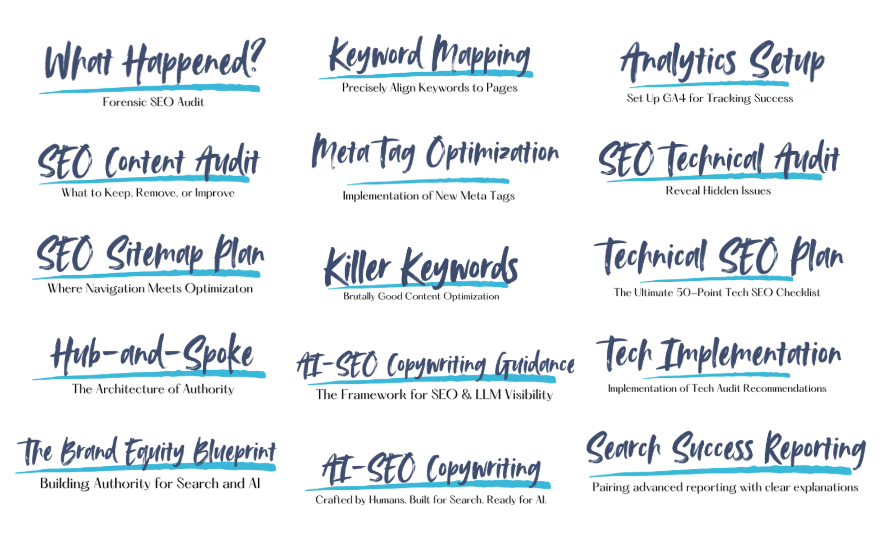
Deliverables should include, at the very least, initial up-front audits and strategy plans, followed by recurring tasks for monthly content ideation and/or generation and monthly reporting. Most importantly, there should be a recurring call, at least once per month, where they keep you informed on the status of each task and explain your reporting in plain and actionable terms: what’s working well, what’s not working so well, and what should be done about it.
How to Choose the Right SEO Partner

A reputable SEO agency or expert will:
- Be extremely transparent. Use the “no hat” question above to really dig into exactly what they do and how they do it. They should not breeze over any details or refer to any magical behind-the-scenes tactics.
- Be willing to educate. Express that you want to learn more about how SEO works and that you expect to gain an education along the way. If they make excuses for why that’s not possible or how that is unnecessary because they’ve “got you covered,” then run!
- Be respectful. Don’t ever let an SEO expert talk down to you or make you feel stupid for asking certain questions.
- Be communicative. Once monthly calls should be the minimum expectation for live communication between your SEO agency and yourself. That should be even more frequent in the beginning. Email-only communication should be considered unacceptable. There’s no replacement for dynamic strategy discussions between the SEO experts and the client.
- Be willing to share references and case studies. Request them both, and be very wary of any hesitation or delays. Be sure to actually contact the references as well – do not let them gamble on the fact that you won’t follow through on that part.
- Have good reviews and testimonials. Don’t ask for these – look for them yourself. Any agency worth their weigth in salt will have positive online reviews and testimonials.
- Demonstrate thought leadership. Be very cautious of an agency or “expert” that doesn’t have a long roster of publishing their own thought leadership in the industry. You should easily be able to assess their reputation in the SEO industry by looking through their own website articles, articles they’ve written for industry journals, mentions they’ve earned in the press, measuring their social following, and seeing them as guests on podcasts and webinars, or as book authors or adjunct professors.
- Have experience in your industry. While the search engines work the same for nearly all industries, an SEO partnership should be a true marketing partnership. The SEO team should understand how your business works, the DNA of your target market, the length of your sales cycle, etc.
- Not treat “GEO” separately from SEO. A true expert in the art and science of building online visibility does not delineate between efforts to get found in search engines and efforts to build visibility in AI. They are one in the same. Yes, there are some new layers of techinques specific to the AI visibility part of things, but it all starts with traditional SEO. Anyone who tries to tell you otherwise clearly doesn’t understand the fact that AI chatbots use SEARCH ENGINES to search the web, duh!
Are We The Right SEO Partner for Your Brand?
At Pam Ann Marketing, we have been providing white hat SEO services for over 15 years. We’ve worked with over 500 brands across a wide variety of industries. We’re transparent, communicative, and well-respected in the industry. Contact us today to book a call with Pam and see if we might be the right partner for your SEO journey!

- How to Optimize Your Article Content for SEO and GEO/AEO - August 28, 2026
- Why All AI-SEO Studies are Flawed (and What to Trust Instead) - March 12, 2026
- How Much AI-Generated Content is Acceptable for SEO Writing? - February 25, 2026