





What is Keyword Mapping?
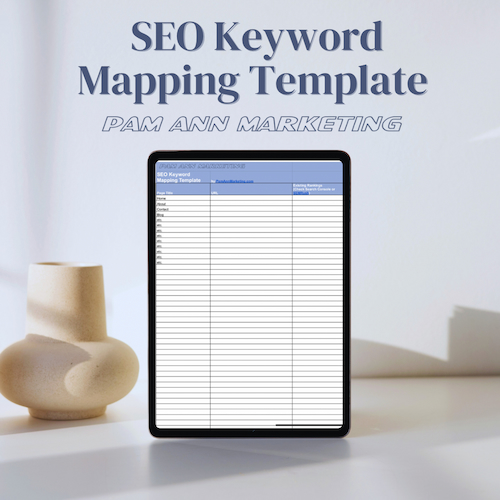
Keyword Mapping is an SEO practice where keywords are strategically organized into groups and “mapped” (assigned) to certain pages on a website. It involves researching keywords, grouping them by topic and intent, assigning primary and secondary key phrases to each page, and preparing meta tag content for each page. It also provides a basis for tracking the desired keyword ranking performance for each page.
On this page, you can:
- Read about what keyword mapping is
- Learn how to do it
- Download our FREE keyword mapping template
- Read FAQs related to keyword mapping
TL;DR: Keyword mapping is the act of assigning key phrases to website pages. It is done by performing keyword research, then deciding which pages are the best fit for which keywords. It’s a highly recommended SEO exercise that leads to markedly improved organic search results.
Does Keyword Mapping Actually Work?
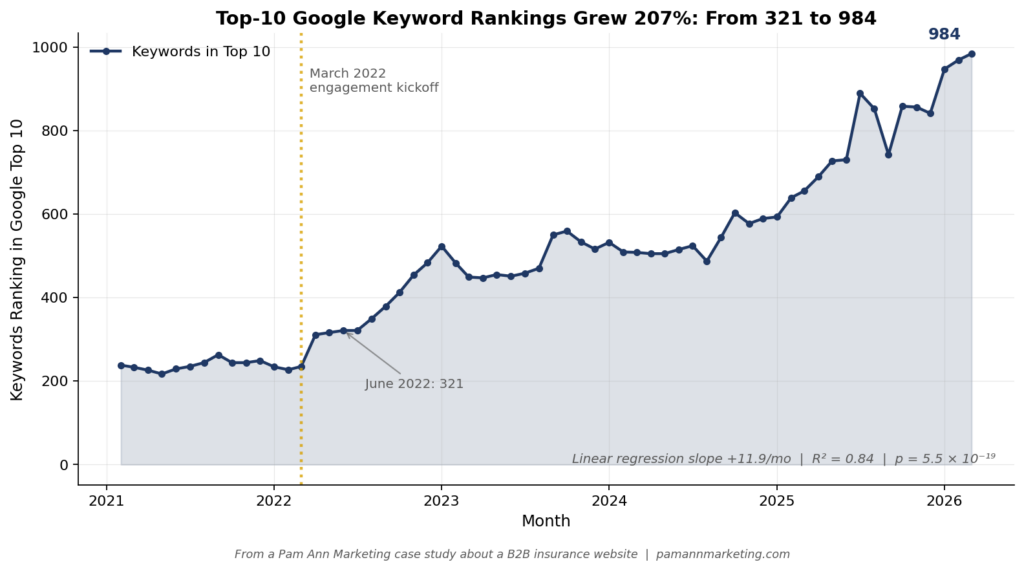
We have measured the positive effects of keyword mapping in our own client work.
For example, a B2B specialty insurance provider we have been working with over the past three years saw their number of top-10 Google search results positions increase 207% after consistently implementing our strategic keyword mapping as a core component of a coordinated SEO program. Click here to read the full case study.
What is an SEO Keyword Mapping Template?
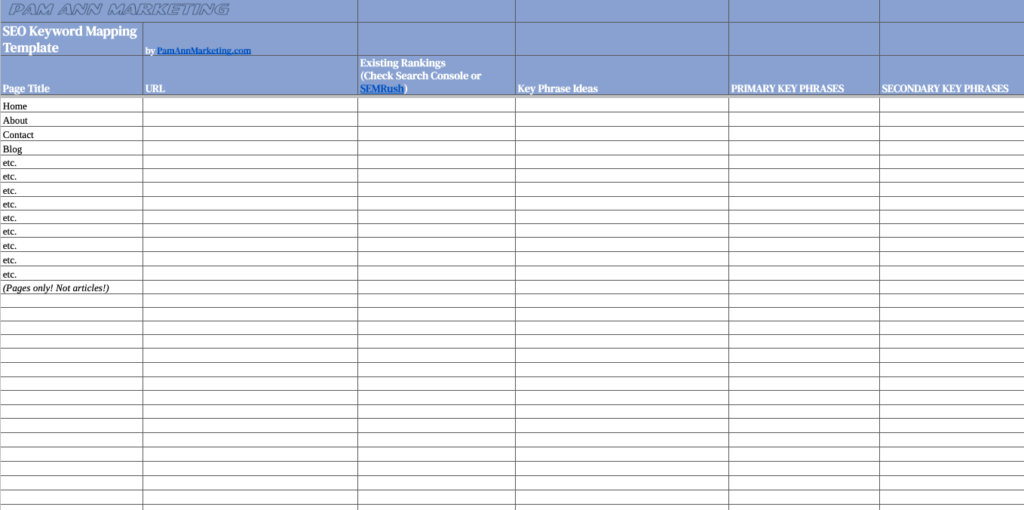
A keyword mapping template is an SEO spreadsheet used to “map” keyphrases to pages on a website.
Why Map Pages on a Separate Template from Blog Posts?
This Keyword Mapping Template is different from an SEO Blogging Schedule Template, as it focuses only on your site’s static core pages. But why do we do it that way?
The reason we keyword map pages separately from blog posts is that pages should be mapped with high-intent keywords, and informational articles should be mapped with lower-intent keyphrases. Keeping these keyword trackers as separate templates puts a clear delineation between them, and serves as a tangible reminder to not mix up those intentions.
Earlier in the days of running my SEO agency, I saw clients unintentionally mapping high-intent phrases to blog posts and vice versa. This was leading to keyword cannibalization and overall confusion for the crawlers as to which URL was about what thing. I decided to try an experiment, which was to split the keyword mapping spreadsheets into two: one for pages, one for blog posts. The results were nearly instant. That simple separation made it clear in everyone’s minds that one spreadsheet was for high-intent and the other was for informational phrases. Problem solved!
Why is a Keyword Mapping Template Beneficial?
A keyword mapping template is an essential strategic component of any SEO effort.
- Visualization: Helps visualize and optimize website structure and content
- Organization: Keeps your content optimization efforts organized
- Collaboration: Can be shared with others among your team or outside vendors such as copywriters
- Efficiency: Saves time by providing a streamlined workflow for the keyword mapping process
- Avoids Keyword Cannibalization: Helps ensure that your pages do not compete with each other in search results (also known as “keyword cannibalization”)
- Tracking Results: You can periodically return to the spreadsheet after implementation to assess keyword performance for each page, and reassess the selected keywords if needed
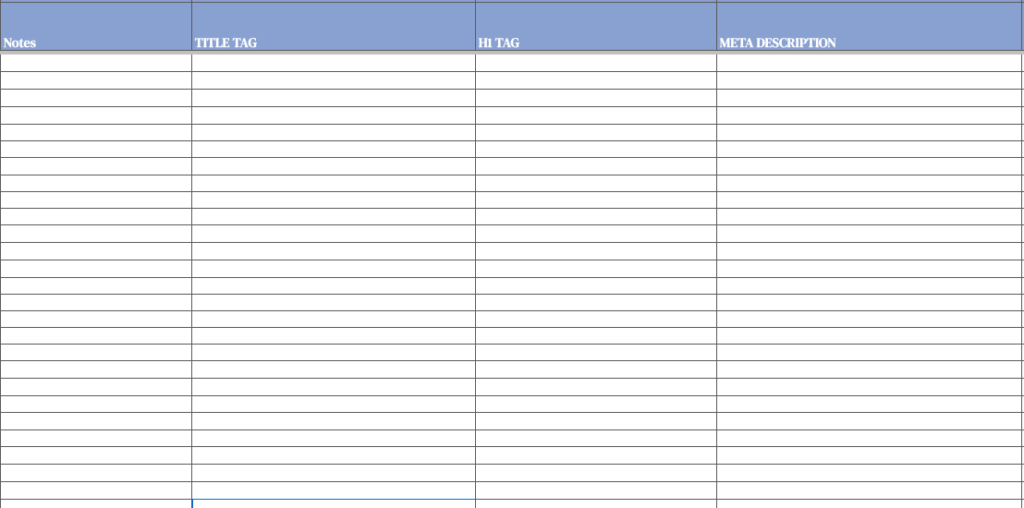
What are the Key Components of a Keyword Mapping Template?
Our keyword mapping template has columns for:
- Page Name: Short nickname for the page, i.e. “Home”, “About”, etc.
- Page URL: The URL of the page to be optimized
- Existing Keyword Rankings: What keywords the page is already ranking for (if an existing page) with their current position and search volume
- Keyword Ideas: Possible keywords for the page, with information about search volume (SV) and keyword difficulty (KD)
- Primary Keywords: Your finalized selections for primary key phrases to be used on the page
- Secondary Keywords: A list of possible secondary key phrases to be used on the page. This can also include question phrases and subheadings.
- Title Tag: Your draft for the SEO Title Tag (how you’ll word it to include the primary key phrases)
- H1 Tag: Your draft for the H1 tag (how you’ll word it to include the primary key phrases)
- Meta Description: Your draft for the meta description for the page (containing primary and perhaps secondary key phrases)
- Notes/Comments: Anything that should be kept in mind when planning the content for the page, for example, notes about the search intent of the keywords selected for the page or the priority for getting it written (or rewritten).
How to Fill Out a Keyword Mapping Template
Reminder! You can download our free keyword mapping template spreadsheet below.
1) Start with keyword research
First, you want to do keyword research to compile a master list of all of the phrases that are relevant to your content. This initial “keyword dump” will give you a database of phrases to choose from when you start the keyword mapping exercise. You can use a tool like Mangools KWFinder, or you can even just search phrases in Google and look at the “People Also Ask” and “People Also Search” phrases.
Pro tip! Don’t forget to include the keywords your content is already ranking for! Too many times, I’ve seen people do a keyword mapping exercise with a blind eye toward their existing rankings. Then, they accidentally end up fixing what wasn’t broken. If you are keyword mapping existing content, be sure to identify the phrases that each page is showing up for before you begin, and add them to the keyword mapping template under the “Existing Rankings” column. This will ensure that you remember to preserve the phrases that are already working for you.
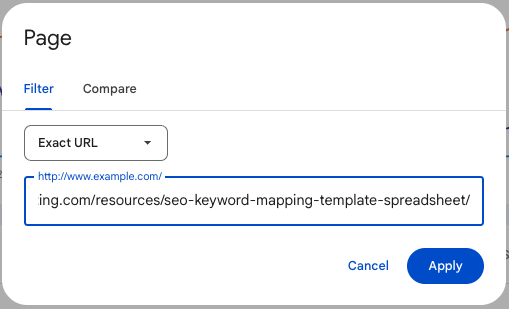
You can find these phrases in Search Console. Go to the “Performance” report and click “Add filter.” Then change the dropdown to “Exact URL” and insert the URL.
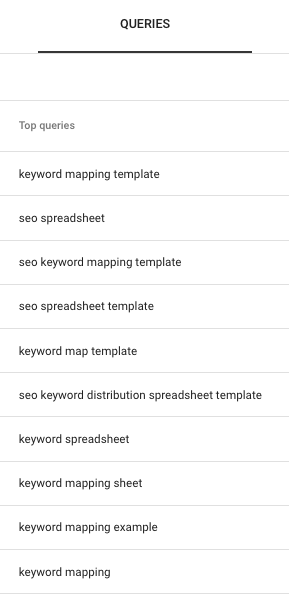
You will then see a list of all queries (keywords) that specific URL has visibility for in Google search results.
2) Then pair keywords with URLs
Now it’s time to start mapping. Go one page at a time, but feel free to jump away briefly to jot down an idea for another page if you have one (the Notes column is great for this). This exercise tends to really fire up some intense brainstorming, which is one of the many things I love about it!
Selecting Primary Keywords
First, you will want to select primary keywords for each page. Remember, only high-intent phrases should be mapped to static website pages. Save informational queries for secondary keywords and future mapping to informational articles.
When selecting primary phrases, look at how you might be able to combine them into a page title, because that’s one of the places you will need to use them. The title is very prominent on the page, so your users will certainly see it. Keep this in mind. I used to not emphasize this too much, but over the years, I saw so many clients simply say “yes, I want to rank for that” for every keyphrase we put on their mapping sheet, only to have them later on say that they didn’t want to use such phrases so prominently in their titles. Now, I open every keyword mapping review call with a script that includes the following:
“Keep in mind that any keyword phrases that you want to rank for will have to be prominently included in your content.”
Here is an example of how multiple primary keyphrases can be combined into a page title:
- seo agency
- woman-owned agency
- award-winning agency
Can all be combined into one page title as “Award-Winning Woman-Owned SEO Agency.”
Things to Keep in Mind When Selecting Primaries
In addition to that, keep the following in mind when selecting primary keywords as well:
- Check Keyword Competition & Search Volume Analysis (Supply / Demand): You want to target keywords that have a strong search volume while also being realistic to rank for, based on competition levels. Avoid overly broad or extremely competitive terms that might be difficult to gain visibility for.
If you don’t have a keyword research tool that gives you search volume and competition metrics, you can simply look at the existing search results for any given keyword. If the results are dominated by extremely popular websites that your site would be unlikely to outrank, then skip that phrase and find a phrase where the search results contain sites more similar to yours. - Check Context: Review the keywords to try to ensure it aligns with your services, audience, and industry language. Always look at and follow the search engine’s existing understanding of a term. If Google consistently ranks pages that focus on one meaning of a keyword, and you’re talking about something different, you’re not going to be likely to rank. So make sure to select keywords where Google’s interpretation of the meaning of the phrase tightly matches your content’s intent.
- Favor Non-Branded Keywords: For this exercise, you’ll want to lean heavily toward non-branded industry keywords rather than terms containing your own brand names or competitor names. The owner of each branded term, whether you or a competitor, is most likely to dominate the search results for that term, which is why it’s important to pick mostly or entirely non-branded keywords. You’re likely already succeeding with ranking for your own branded keywords, and you’ll be unlikely to succeed trying to rank for your competitors’ branded terms, so just stick with non-branded.
- Look at your PPC keywords: If you do SEM (Search Engine Marketing) a.k.a. paid search, review your paid search keywords to ensure alignment with your SEO efforts, and vice-versa. It’s important for your paid search keywords to tightly match the wording on your landing pages, so if you’re sharing landing pages between SEO and PPC efforts, it’s crucial to keep the phrasing all in tight alignment.
Selecting Secondary Keywords
Secondary keywords are supporting terms that provide additional context to the page. These help show the search engines that you have comprehensively covered your topic. This improves the page’s relevance for your primary keywords and overall ranking potential.
Secondary keywords can be informational in nature (low-intent). Question phrases also make for great secondary keywords, and they’re great for AI-SEO optimization because AI crawlers love FAQs presented in a structured question-answer format.
FAQs About Secondary Keywords
Q: How many secondary keywords should I choose?
A: There is no numerical minimum or maximum for this purpose. The idea is to choose as many as you think you can weave in naturally. Try to collect a variety of secondaries that show the related concepts of your primary phrases. For example, “SEO services” as a primary phrase should be supported by secondaries such as “keyword research,” “technical SEO audits,” “domain authority,” and so on. The idea is to demonstrate that you’ve covered the topic comprehensively.
Q: Where can I find secondaries if I don’t have a keyword research tool?
A: You can simply search your primary keyword on Google and look for the “People Also Ask” and “People Also Search.”
You can also use this prompt to ask Gemini (go to gemini.google.com) what the related entities are in Google’s Knowledge Graph:
Using the Google Knowledge Graph API, create a very simple, high-level chart identifying what the related entities are that have relationships with this keyword: [insert your primary keyword]You will then get a result like this, which tells you the different related concepts that Google would expect you to talk about in a page that is focused on your primary keyword:
The following chart outlines the high-level relationships and related entities commonly associated with an SEO agency within the Knowledge Graph.
Entity Relationship Chart: SEO Agency| Relationship Category | Related Entities | Relationship Description |
|---|---|---|
| Parent Industries | Digital Marketing, Advertising, Information Technology | The broader economic sectors the entity belongs to. |
| Core Services | Search Engine Optimization, Content Marketing, Link Building | The primary “attributes” or offerings of the organization. |
| Related Concepts | Search Engine Results Page (SERP), PageRank, Web Traffic | Semantic topics that provide context to what the agency does. |
| Associated Platforms | Google Search, Bing, YouTube | The environments where the agency’s work is performed. |
| Primary Tools | Google Search Console, Google Analytics, Ahrefs, Semrush | Entities often mentioned in the same context as the agency’s workflow. |
| Key Roles (People) | SEO Specialist, Digital Marketer, Web Developer | The human entities that typically compose or interact with the agency. |
Q: How often do I need to mention each secondary keyword in the content?
A: Secondaries only need to be “peppered in.” Just use them once or twice throughout the content, always in a natural way.
For more on how to use primary and secondary keywords in your copy, download our free SEO Copywriting Guide!
But first, start by downloading our free keyword mapping template spreadsheet below.
3) Group keywords by theme to match user intent
In order to avoid multiple pages competing for the same keyword, you will want to take a theme-based approach to keyword selection. This means that each page is assigned a distinct keyword theme, ensuring search engines understand which page to rank for a given query. This prevents confusion that could dilute visibility and ensures each page has the best chance of ranking for its intended topic.
Here is a very simple example:
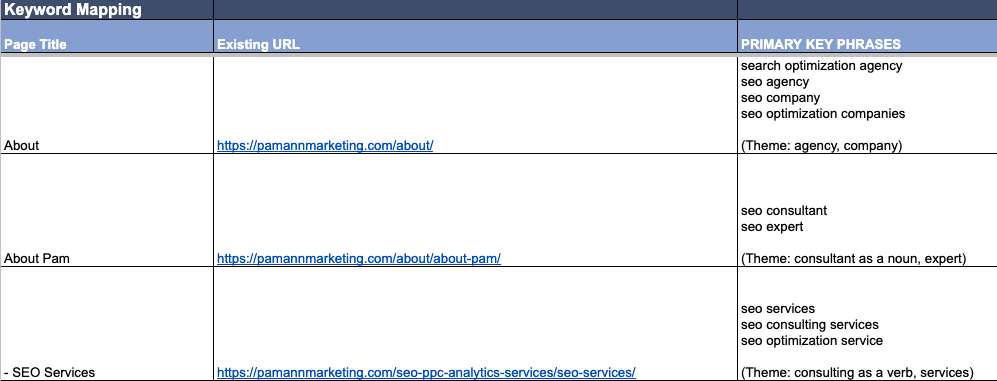
Here you can see that we assigned the themes as follows:
- The About page was assigned the “agency/company” theme, as that is the page that gives the company’s information
- The About Pam page was assigned the “expert/consultant” theme (with “consultant” as a noun), as that content is about Pam as a person with expertise
- The SEO Services page was assigned the “services/consulting” (with “consulting” as a verb), as those are the activities that this page describes.
This also demonstrates the importance of matching user intent. Users searching for “SEO services” are not necessarily looking to read about me as a person, or at least not yet. They want to land on the content that describes the thing they were looking for.
Matching user intent like this helps reduce “pogo-sticking,” which is an SEO industry term for when users click on a link in Google search results and immediately jump back to the search results because they were unsatisfied with what they saw.
4) Optimize the content
Pro tip: Keyword map all of your content BEFORE updating it! Too often, I see people keyword map and then optimize one URL at a time, but then they reach a page later in the list and decide that page was a better fit for a keyword they already used earlier. Since you want to avoid using the same keyword as a primary on more than one page, this means you need to go back, pick a new keyword for the earlier phrase, and then re-optimize that content again. It’s best to map all phrases first, THEN start doing your optimizations.
Once you’re ready to optimize your pages with the keywords that you mapped, head over to download our free SEO Copywriting Guide! That will walk you through exactly how and where to use your primary and secondary keywords on each page.
Need Help With Your SEO Keyword Mapping?
Need help filling this out? Check out our AI-SEO Services or our SEO Training offering.
Download Instantly for Free!
This SEO Keyword Mapping Template is a key component of any successful SEO strategy. Download it right now for free! It’s in Google Sheet format, but you can download it from there as an Excel file if desired.
FAQs About Keyword Mapping
Q: What’s the difference between high-intent keywords and low-intent ones?
A: High-intent refers to a keyphrase that indicates a user is ready to spend money. For example, “SEO services” indicates that the user is looking to engage with an SEO firm and pay them for their services. On the flipside, “What is SEO?” is a low-intent key phrase. It is clear that the user isn’t ready to spend money right now. There are also phrases that are mixed-intent or unclear. For example, “SEO keyword mapping.” That user may be looking for a free template like this one so that they can do the exercise themselves, or they may be looking to pay an SEO agency to do it for them. In those cases, I recommend pairing the mixed intent keyphrase with either a high-intent one (if you’re mapping a product or service page) or a low-intent phrase (if you’re mapping an informational article).
Q: Should I map keywords before or after writing the content?
A: Always before, whenever possible. Of course, for existing content, you have to do it after the content is written. But for new content, it’s so much better to do the keyword mapping exercise before you begin writing. This way, you can more easily weave the keyphrases in naturally, which is super important. Efforts to optimize already-written content can often come out sounding a bit “stuffed.”
Q: For my e-commerce site, should I keyword map all of my product pages?
A: Not necessarily. A lot of times, product names end up being so descriptive that they don’t necessarily need keywords mapped to them. Instead, focus on your product category pages. Those are incredibly important landing pages for SEO purposes. Assigning high-intent-to-buy phrases to these URLs is a more worthwhile exercise than focusing on each product page.
That being said, if your product pages are very thin, or you are the manufacturer and have not yet woven in non-branded keywords to your product titles and descriptions, then absolutely work on keyword mapping the product URLs. I still suggest that you start with categories first, though, as they are more likely to bring in non-branded searchers (users searching for a solution who don’t yet know your brand name).

- How to Optimize Your Article Content for SEO and GEO/AEO - August 28, 2026
- Why All AI-SEO Studies are Flawed (and What to Trust Instead) - March 12, 2026
- How Much AI-Generated Content is Acceptable for SEO Writing? - February 25, 2026