






This article has an associated webinar! Register here to watch it on demand.
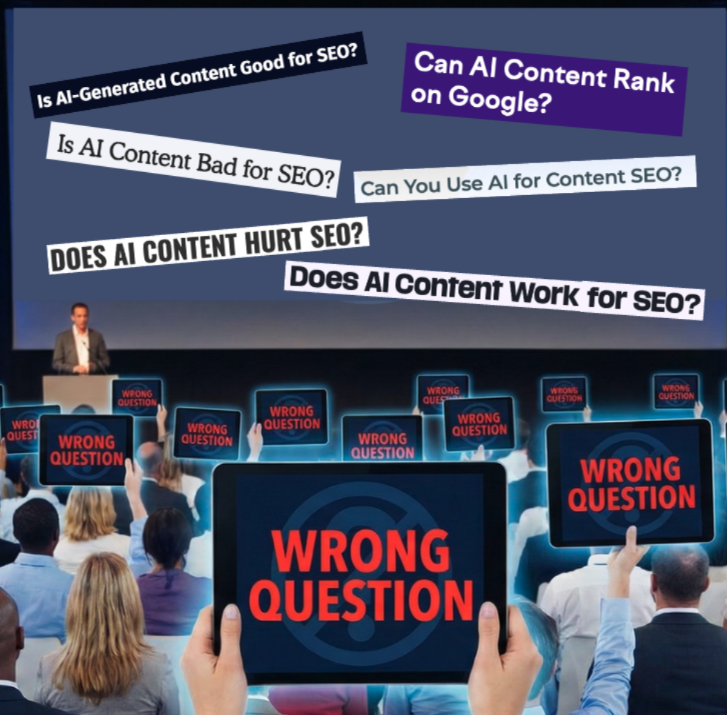
These days, most people are asking, “How much AI can I use in my content before Google punishes me?”
This is the WRONG question, and it completely misses the point.
Google doesn’t explicitly punish AI-generated content; it punishes “hollow” content.
AI tends to produce “hollow” content, so it can seem logical that too much AI = Google won’t rank it, but the reality is the inverse: Too little human experience = Google won’t rank it.
In order to succeed in this new era of AI-powered search, you need to flip the “how much AI” question on its head.
The TL;DR (“Too Long, Didn’t Read”)
“How much AI can I use in my content before Google punishes me?” is the WRONG question.
Instead, ask yourself, “What depth of human experience have I added to this?”
The ELI5 (“Explain It Like I’m Five”)
What is E-E-A-T?
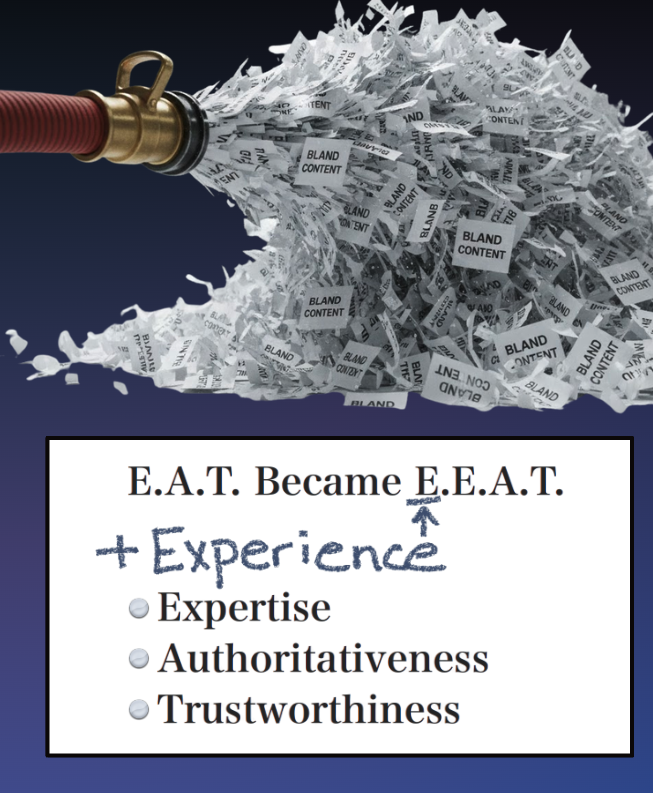
In direct response to the firehose of bland, generic, repetitive content that started flooding the web after the launch of ChatGPT, Google expanded its E-A-T guidelines (Expertise, Authoritativeness, Trustworthiness) to include a new “E”: Experience.
Search engines and AI chatbots are engineered to trace information back to original, firsthand human sources. They want to avoid machine-generated summaries of other machine-generated content. That’s why Google added this new “E” to encourage you to include your personal, real-world, firsthand HUMAN life experience in your content. The one thing AI can’t replicate is personal insights gained from real-world human experience.
Expertise, Authoritativeness, and Trustworthiness still very much matter, but injecting your content with a healthy dose of the new Experience “E” is really the only way to outshine the endless amount of generic, repetitive advice on the web, which has grown exponentially since the launch of ChatGPT and similar generative AI tools.
Forget the Amount of AI, Focus on the Amount of “E”

Everyone thinks that Google cares about how many of your words are AI-generated versus human-generated, but that entirely misses the point!
The point is: Search engines and AI chatbots are engineered to trace information back to original, firsthand human sources.
It’s literally impossible to be considered an original source if you’re churning out bland, AI-written content. In fact, even if you write all your words by human hand, you can still fall into the trap of writing content that’s too lacking of the new “E” to rank well!
And most importantly, content with a good amount of “E” not only ranks well, but also resonates with humans better. It’s a win-win: including your personal real-world experiences in your content not only makes it more visible in search and AI, but also resonates better with your target audience, leading to higher levels of trust and conversion.
This new “E” is the key to unlocking levels of visibility for your brand that simply won’t be reachable if you are using AI to fully generate your content.
And it aligns perfectly with the evolution of search.
How Search Evolved
I’ve been doing SEO for over 20 years now. Back in “the day,” I sat there and stuffed as many different synonyms into a meta keywords tag as I could think of. Today, I’m sitting here preaching to you the importance of putting your real-world, lived situations into your content.
I’ve seen search go through countless changes, but I can easily distill them down into three distinct levels of evolution.
“Level 1” Primitive Search Engines
20 years ago, search engines struggled to identify “things.” They only knew words. It was nearly impossible for them to tell the difference between the word “apple” when referring to a fruit versus “Apple” when referring to a phone. The fact that the word “apple” was present was all that mattered when Google was a simple word-matching engine.
“Level 2” Entity-Based Search
Over the years, search algorithms have evolved to incorporate machine learning. This helped search engines understand entities. An entity is a thing, and that thing can be a person, a place, a type of food, etc.
Search engines were now able to “know” what things are.
For example:
- An apple is a thing. It can be one thing (a fruit) if in the context of food, versus another (a brand) in the context of technology.
- An orange is a thing. It can be either a color or a fruit, based on the context of the surrounding words.
- Fruit is a thing. It is a category of food items that includes apples, oranges, and other seed-producing produce.
- A brand is a thing. It is the name of a company or product.
This new “knowledge” took SEO to another level. We no longer had to type in every synonym under the sun. We could rely on the fact that the search engine “knows” that fruit is food without us having to stuff in both keywords.
“Level 3” AI-Powered Search
Over the past several years, search got even more intelligent. Large Language Models (LLMs) and Natural Language Processing (NLP) are now fully embedded into search, on top of the entity-based machine learning.
Now search engines can understand meaning, sentiment, intent, and more. And they most certainly can understand the difference between words that refer to real-world experiences and those that don’t.
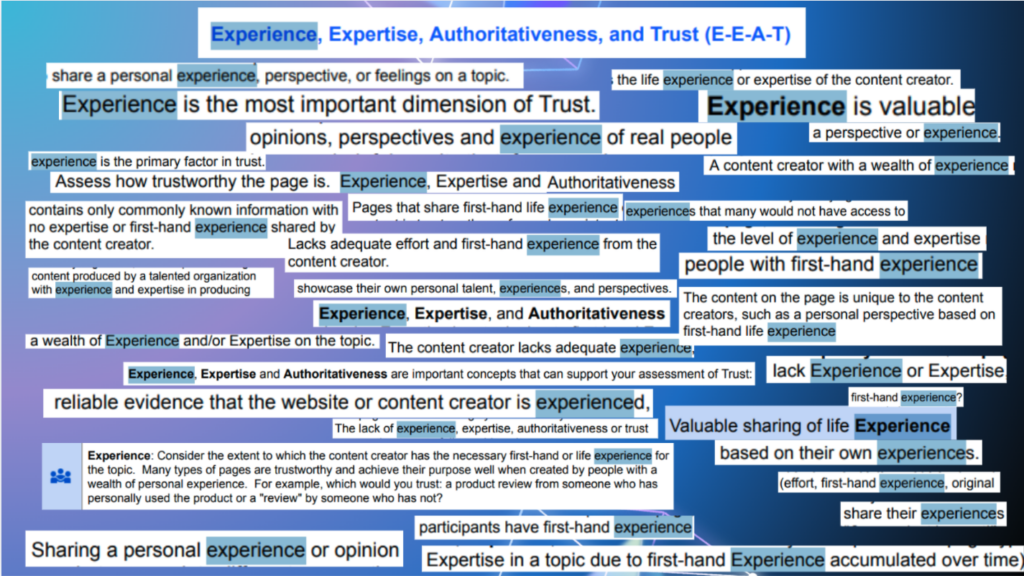
Google, the unquestioned leader in the search industry, has decided that this factor – this new “E” – is what content MUST contain in order to be considered high quality. They have straight-up told us so by not only modifying their E-A-T acronym to E-E-A-T, but also talking about this factor repeatedly in their revised Quality Rater Guidelines:
And it makes perfect sense, given that search engines and AI chatbots are engineered to trace information back to original, firsthand human sources.
(Yep, I’m going to keep repeating that so it sinks in!)
My Level 3 Content Quality Framework
To align perfectly with the evolution of search engine intelligence, I’ve developed what I call the “Level 3 Content Framework.” Here’s what that looks like, and how it aligns with the evolution of search.
“Level 1” Content
Search Engine Level of Understanding
At level 1, there was no “understanding” – search engines simply did word-matching.
- “Brand” is a word.
“Level 1” Content Example
At this level, we were able to write what was essentially gibberish and just keyword-stuff all word variations into it.
“When researching top brands, it is essential to analyze the branding techniques used to create heavily branded products. A professional brander understands that avoiding brandless or entirely unbranded merchandise is crucial for achieving maximum brandedness within a market. Furthermore, establishing a recognizable brand name and a strong brand identity often requires a comprehensive brand strategy. Sometimes, an organization must execute a complete rebrand to launch a brand-new product line, such as a retail house brand. Ultimately, the goal is to secure long-term brand loyalty, leaving a permanent mark on the consumer’s mind much like a traditional branding iron.”
AI’s Role
AI can definitely do this, but no one should be publishing this crap anymore!
“Level 2” Content
Search Engine Level of Understanding
At level 2, search engines became able to “know” what things are and the relationships between them.
- A brand is a thing. It is the name of a company or product.
- A brand is related to other things, including logos, slogans, products, core values, etc.
- A brand can be assigned to products, companies, or individuals.
- Branding is the act of creating a brand strategy and its associated assets.
- Examples of brands include: Apple, Google Microsoft.
“Level 2” Content Example
At this level, it became necessary to write comprehensive and intelligent educational content, ensuring that we naturally touched upon all related concepts. For example:
“Beyond the Logo: What Exactly is a Brand?
At its core, a brand is a perception. It is the collective emotional and psychological response that people have when they interact with a company, product, or individual.
The Anatomy of a Brand:
- Brand Identity
- Brand Voice
- Core Values
- The Brand Promise
Why Does Branding Actually Matter?
- It Builds Trust
- It Creates Customer Loyalty
- It Commands a Premium Price
The Bottom Line
A brand is a living, breathing entity. It is shaped by every single interaction. Master those touchpoints, and you’ve built a brand.”
AI’s Role:
AI is very good at generating Level 2 content. It does so all day, every day. The web is absolutely saturated with Level 2 content at this point.
“Level 3” Content
Search Engine Level of Understanding
At this point, search engines have now reached “Level 3” understanding of written content. They understand the full meaning of all sentences, contexts, sentiments, intents, etc., to the same degree a human does, and the algorithms look for evidence of original human insight that was gained through real-world experience.
“Level 3” Content Example
In addition to reaching “Level 2” comprehensiveness, we now need to take content to “Level 3” by including the new “E” – real-world “Experience.” For example:
When we were developing a brand for a premium coffee line, we had a choice: focus heavily on the client’s sourcing of the absolute rarest beans, or focus on creating an immersive in-store experience with highly trained baristas.
Our custom survey data suggested rare beans would give our client a slight edge in brand perception, but our market research indicated customers were willing to pay significantly more for the ‘experience’ and perceived status of a high-end coffee shop.
We chose to prioritize the experiential branding, knowing it meant foregoing the differentiator of bean exclusivity, because we projected it would yield greater pricing power and loyalty.
That’s the type of “Vitamin E” you need to inject into your content in order for it to outshine the bland, generic content that’s flooding the web and win rankings in both Google and AI chatbots.
AI’s Role:
AI fails at this. Here is where YOU can rise above the noise!
How to Demonstrate Experiential “E”
Ever since Google introduced the new “E”, I’ve been preaching the importance of it, but I struggled to find a way to measure just how much of this “E” factor a piece of content contains.
Writing in first person is a good start, but it’s not enough on its own; It won’t reach the level that we’re aiming for, which is to become the original source of 100% unique, experience-driven insights that search engines and AI chatbots will want to bring to people’s attention.
I needed to establish a process for my team to review client content and make a clear determination as to whether the piece sufficiently demonstrated real-world experiences.
Knowing that Natural Language Processing is used by search engines and AI chatbots to understand content, I did some deep research into how NLP can recognize when a human is sharing memories of lived experiences and the knowledge acquired from them.
My research led me to a field of study called “cognitive linguistics,” which focuses on the science of using language to match the way the human brain naturally processes information. I uncovered a variety of linguistic signals that can identify when humans are sharing their cognition (their knowledge) that they gained from their experience. There’s a long list of them, and they all have very “sciency” names, so I decided to break them into three very simple categories.
1. “Over The Years” Stories
Storytelling is an incredibly effective way to resonate with human readers, and it can also serve to check the “Level 3” box, particularly when you pick stories that demonstrate just how long you’ve been doing what you do and how your approach has changed over time.
Focus on telling stories about real-world lessons learned and the specific time and place they came from when you personally experienced them.
- Times and Places: Stories that explicitly reference specific times, locations, or histories can help “ground” your expertise to your experiences.
Beyond mentioning historical times and places, these specific types of stories offer particularly clear signals of lived experience that spanned significant lengths of time:
- Rules of Thumb: Stories about your (or your company’s) unique rules-of-thumb for your profession that were acquired through long-term immersion in the field and the specific situations that led you to adopt them.
- The Methods to My Madness: Stories that explain the evolution of your (or your company’s) methodology over time, identifying which “standard” industry practices you retained, which you modified, and which you discarded as your personal expertise matured.
- Long-Term Effects: Stories that describe subtle, secondary, or long-term effects of an approach that one can only have experienced after doing a profession for a long time.
Talking about things that happened to you and how your advice is deeply tied to your own lived experience is a solid way to elevate your content to Level 3.
My personal example (Times and Places, Long-Term Effects):
“When I spoke at WordCamp US in 2019, a woman came up to me after my talk and asked me a very interesting question about a rebranding challenge. Her company had been acquired and was tasked with ‘rolling up’ several other brands and websites into their own. Management was leaning toward a quick transition, but was also open to approaching the unification gradually if it meant a better end result for SEO. I told her about the biotech client I worked with back in 2013 who faced the same dilemma and went with the quick-transition approach. I explained that it ended up taking them six whole years to get the new parent brand to the level of SEO visibility that could have been achieved much sooner with a more gradual approach to merging the sites.”
2. Pivot Points
This group of techniques includes various ways of describing changes in beliefs or processes as a result of lived experiences.
- Belief Pivots: Explaining a fundamental shift in a professional belief resulting from real-world situations.
- Procedural Pivots: Describing how your approach to your profession has evolved and how your standard operating procedures have changed accordingly.
- Paths Not Taken: Describing what you chose NOT to do in a given situation (trade-offs you made) and your reasoning behind your decision.
These “Pivot Point” techniques take content to Level 3 by tying advice to identifiable professionals who went through real-life trial-and-error and learned from it.
My personal example (Belief Pivot):
I used to be an AI-generated content “purist.” I felt that no amount of AI-generated content was safe for SEO purposes. I maintained this belief for the past three years, but after intensive research and experimentation, my belief pivoted. I now believe, as detailed in this article, that it can be “safe” to use AI to help generate content, so long as it contains enough of the experiential “E” to ensure that it will absolutely shine in comparison to the typical bland, generic, repetitive purely AI-generated content.
3. The “Only The Pros Would Know” Stuff
This involves demonstrating your deep understanding of complexities and dependencies learned through extensive first-hand experience. These are the things that “only the pros would know.” They are not taught in the classroom or included in the “handbook” of standard industry best practices.
- Discussing Complexities: Talking in-depth about dependencies (how one concept impacts another), complex decision-making challenges, and ripple effects that can be caused down the line by earlier decisions.
- Theory vs. Reality: Talking about the friction between what you’re supposed to do in theory and the real-world constraints that get in the way.
- Exceptions and Edge Cases: There’s an exception to every rule, and the more you talk about them and the unique edge cases you’ve encountered, the greater you’re demonstrating your experience.
- The Point of No Return: Talking about situations where a decision was made or a thing happened (e.g., a global pandemic), and the effects were so intense that there was no turning back. Explaining how you navigated such situations and new realities demonstrates your “battle scars” from the real world and how you survived challenges that other, less seasoned professionals would not have.
My personal example (Exceptions and Edge Cases):
“I typically advise clients to try to avoid using subdomains versus subdirectories; however, in cases where a different content management system is being used to power a portion of the site, this is not feasible and a subdirectory approach in that case can lead to more technical problems than the subdomain approach.”
The Level 3 Content Quality Checker
You can use the above framework as a simple guide to injecting your content with “Vitamin E.” But if you’re like me, you’re probably craving a way to actually measure the potency of the real-world experience that your content demonstrates. So I’ve developed a content analysis tool that scans for the linguistic techniques mentioned above.
The Level 3 Content Quality Checker greatly simplifies the task of assessing whether your content has sufficient evidence of human experience (“Vitamin E”) to succeed in SEO.
How the Level 3 Tool Works
To achieve Level 3, the tool must see linguistic evidence that you included at least one of the techniques from the above groups:
- “Over the Years” Stories
- Pivot Points
- “Only the Pros Would Know”
The tool will classify content as Level 3 if it sees any of those linguistic signals.
It also contains a suggestion generator to help you come up with ideas for how to incorporate Level 3 elements if they aren’t there, or how to add more of them even if you did already reach Level 3. The more “Vitamin E,” the better!
And best of all, the Level 3 Content Quality Checker tool is completely free for a limited time while in beta!
How to Use the Level 3 Content Quality Checker for FREE
To receive free early access to this tool, visit https://contelevate.ai.
Key Takeaway: It’s All About That “E”
Regardless of whether your article was written 100% by human hand, or in part by AI with human-added elements, the end result should always land in Level 3. By nature, Level 3 cannot be achieved by AI alone, but the exact percentage of human editing should be considered irrelevant to whether or not the content piece as a whole satisfies the Level 3 requirements.
If you’re not including enough Level 3 “E,” then your content is not closing enough of the information gap between an average AI-generated article and a piece that is going to have long-lasting high performance in search.
Bonus Tip: Always Disclaim Usage of AI
If you use AI to help write portions of your content, you should disclose how, why, and for what parts. This is an emphasis in Google’s Search Quality Rater Guidelines.
The idea here is to make it clear what AI did (estimate, summarize, format, suggest), clarify what the human did (authoring, reviewing, analyzing, providing opinions), and add disclaimers about accuracy or intent where needed (e.g., medical, legal, nutritional).
For example, here is my actual AI Disclaimer for this article.
AI Usage Disclaimer for this Article: The vast majority of this article was typed with Pam Aungst Cronin’s own human fingers; however, she did enhance the final version with AI for these purposes:
- To perform spelling and grammar checks
- To establish a logical heading/subheading structure
- To generate the included analogies and examples
Need Help With AI?
From optimizing your website for AI-SEO to AI-powered automation and software development, we can do it all. Reach out today to discuss how we can help your brand ascend with AI.
Webinar: The End of the AI vs. Human Content Debate
This article has an associated webinar! Register here to watch it on demand.
Slides: The End of the AI vs. Human Content Debate

- Why All AI-SEO Studies are Flawed (and What to Trust Instead) - March 12, 2026
- How Much AI-Generated Content is Acceptable for SEO Writing? - February 25, 2026
- How to Spot a “Black Hat” SEO/GEO Scam in 2026 - January 8, 2026