






Posting educational blog or resource articles to your website is a great way to grow your website’s visibility and develop yourself as a thought leader in your industry. Search and AI answer engines reward websites that are continuously adding new, relevant content with genuinely useful information. To ensure your website earns the highest traffic possible, you need to optimize your article content for search and AI answer engines as well as for your human target audience.
TL;DR: Optimizing Articles for SEO and GEO/AEO Requires These Five Things
These five things are what I call the “BAKES” method for optimizing content for both traditional SEO and AEO/GEO:
- B: “Bottom Line Up Front” (BLUF): Write your article’s conclusion first in a clear 2–3 sentence summary at the start of the article, and begin each section within the article in the same way.
- A: AI Structure: AI engines can only process small “chunks” of information at a time, so they love short paragraphs, lots of subheadings, structured lists (bulleted, numbered), and information organized into tables.
- K: Keywords: Traditional SEO keyword optimization is still crucial in the AI era because AI engines rely on traditional search indexes to find content, organic search still drives the vast majority of web traffic1, and more than half of searches serve no AI Overview at all2.
- E: Entities: An entity is a thing, and things have relationships with other things. It’s important to connect these dots in your writing because LLMs and search engines both map content using knowledge graphs that define relationships between entities.
- S: Sources & Stories: Articles that include verifiable stats, peer-reviewed data, or expert quotes are significantly more likely to be cited as authoritative sources by AI answer engines. In addition to citing external reputable sources, contribute your own E-E-A-T (Experience, Expertise, Authoritativeness, and Trustworthiness) in the form of storytelling and sharing your own first-party research.
While they’re all important, read on because the last one is THE absolute game-changer for gaining visibility for your website in this era of AI-powered search.
B: Bottom Line Up Front (BLUF)
What is BLUF?
Bottom Line Up Front (BLUF) is a communications framework created by the United States military in the mid-to-late 20th century to guarantee clear, fast, and precise communication in high-stakes environments. It helped avoid catastrophic miscommunications that can be created by vague or buried information.
It’s also often traced to The Inverted Pyramid style of journalism, which was developed during the American Civil War when telegraph lines could be cut at any moment. The inverted pyramid required reporters to transmit the most critical news first, followed by supporting context, in case they got cut off. In the modern-day context of being a website owner, this advice translates well due to the short attention spans of our human readers and the goals of the AI engines that they’re using.
Why AI Engines Like BLUF
AI engines exist to synthesize vast amounts of text and provide immediate, direct answers to users. If an AI crawler doesn’t find a conclusion in your content quickly, it is highly likely to skip over it. Adopting a BLUF model ensures that the absolute best answer sits at the very top of your page or section, increasing the odds that an AI agent will grab it and quote your business.
Why Human Readers Like BLUF
On top of that, BLUF is how most AI engines formulate their answers, and that’s making human users become accustomed to consuming information in that manner. As if our attention spans weren’t short enough already, they’re getting even shorter with every bit of increased AI adoption. Burying your point in paragraph 3 or 4 is just not going to work for AI engines, nor your human readers.
So start each article, and each section within it, with the core point: State your main conclusion in the first two to three sentences, then follow with context, providing the supporting details, background, or data after the main takeaway.
A: AI Structure
In this AI-first world of web search, it’s crucial to structure the information in your website content so that it is easily digestible by AI engines. This involves flipping a traditional SEO concept on its head: the idea of a single webpage as a single “thing” to be optimized. Those days are over.
AI engines don’t cite full web pages; they cite individual chunks that align with specific user queries. Now, instead of each page of your website being a single optimizable entity, each tidbit of information on each page is its own individual optimizable thing.
To optimize your article content for AEO/GEO, you need to structure it so that every paragraph, block, and section can stand on its own. Each article should be essentially a collection of mini articles. Each distinct section should contain a clear idea or answer that could be cited individually in an AI Overview. Think of your content less as a flowing article and more like a series of very granular and modular, self-contained insights.
Best Practices for AEO/GEO Article Content Structure
- Start the article and each section with its conclusion (BLUF) in the format of a concise answer.
- Write shorter paragraphs (1 to 3 sentences each).
- Put complex information into structured tables.
- Use bulleted or numbered lists.
- Use subheadings (H2, H3, etc.) for every new idea.
- Use subheadings generously. You can even go down to H6 if the complexity of the topic warrants being subsectioned that granularly.
- Be clear: make each subheading as to-the-point as possible, avoid “fluff.”
- Include a hyperlinked Table of Contents for longer pages that have a lot of headings and subheadings.
- FAQs. AI engines love FAQ blocks and list-based answers because they break cleanly into chunks.
- In articles, you can format your subheadings as questions if you don’t want to do a distinct FAQ block, but on product or service pages, a separate FAQ section is best.
- In both cases, ensure that you do keyword research and examine the “People Also Ask” section of Google search results so that you can optimize your questions to match the way users type them in.
- Schema Markup / Structured Data: Embed standardized code (such as JSON-LD) embedded in the article to explicitly tell search algorithms what the content represents (e.g., a review, a recipe, an FAQ).
Overall, you want to try to mimic the format of an AI engine’s response. Try asking an AI engine about your topic, or search it on Google, and examine the format of the response. That’s how each section of your article should look.
K: Keywords
Do Keywords Still Matter?
Absolutely. Traditional SEO keyword optimization is still crucial in the AI era because AI engines rely on traditional search indexes to find content, organic search still drives the vast majority of web traffic3, and more than half of searches serve no AI Overview at all4.
Keyword Research
Before you even start writing your article, you should always perform keyword research to understand which keywords your target audience uses to search for the information you’re giving.
For example, when writing this article, my working title included “How to Optimize Your Articles,” but my keyword research showed me that more people search for how to optimize content than articles. In order to capture both types of searchers, I included both and changed the title to “How to Optimize Your Article Content.”
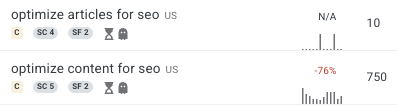
The keyword research tool I used for this is my long-standing favorite, Mangool’s KW Finder.
Optimizing Images for Keywords
Bonus tip! In addition to using consistent wording from your keyword research in your writing, use it to optimize your image filenames and descriptions as well. The filename for the image above is “keyword-research-for-optimizing-article-content-for-seo.png” and the alt text is “A screenshot showing keyword research for ‘optimize articles for seo’ and ‘optimize content for seo’.” See what I did there?
AI-powered search is multi-modal, meaning it can understand multimedia, but it helps to give it context through image filenames and image alt text. Image alt text is also crucial for website accessibility, which helps machines interpret and recite website content to users with visual impairments. Generating accessible web content involves more than just image alt text tags, and that’s beyond the scope of this article, but it’s worth looking into because it’s required by the Americans with Disabilities Act (ADA) and is super helpful to AI engines as well!
Where to Use Keywords in Your Article Content
Here is a list of other places to naturally weave in keywords found during your research:
- Title Tag
- H1 Tag
- Subheading Tags (H2, H3, H4, etc.)
- Meta Description Tag
- URL
- Article introduction and conclusion
- In a list of FAQs
- NATURALLY throughout the copy
It is incredibly important to use keywords naturally in your writing. Keyword stuffing not only puts you at risk of being penalized or suppressed in Google search results, but it also makes you look like a bad, uneducated writer. No AI engine (nor human, for that matter) is going to trust someone who can’t write a cohesive sentence.
Check “CIA” (Context, Intent, Audience) When Doing Keyword Research
When doing keyword research, remember to take into “CIA” account:
- Context: Your assumption of the context of a keyword may not match the search or AI engine’s. Double-check that you have the right context for a term by searching it on Google and examining the Search Engine Results Page (SERP) to ensure that the results are on-topic, especially in the case of acronyms.
- For example, “MTP” can refer to a Metropolitan Transportation Plan (Urban Planning), or Media Transfer Protocol (Technology), or Massive Transfusion Protocol (Medical). When considering the keyword “mtp best practices”, the SERPs are dominated by the medical context, so if you’re an urban planning company or a technology firm, you will not have any chance to get into those results.
- Intent: Users have different intent levels behind their searches, and you should match the intent type to the content type.
- For example, “how to make a pizza at home” clearly has a research/informational intent and is a good fit for an article, versus “order pizza online” has transactional intent and only belongs on a page where the user can complete that action.
- Audience: Similarly to intent, make sure your target keywords match your target audience.
- Using the pizza analogy above, a pizza shop shouldn’t write an article on “how to make a pizza at home,” but a chef who publishes recipes and sells cookbooks should, as that searcher is their target audience. The pizza shop should focus on target keywords such as “number of pizza slices per person” in an article that helps people figure out how many pizzas to buy for a large party.
E: Entities
Google has been utilizing entities in web search since 2012 when it announced it’s Knowledge Graph.5 The company described the concept of entities as “things, not strings.” This is when Google went from Level 1 (a simple word-matching engine) to Level 2 sophistication (an entity-matching engine that could understand the difference between “apple” as a fruit and “Apple” as a company).
When optimizing article content for SEO and AEO/GEO, you want to make sure you touch upon all of the related entities of your topic. This provides clarity on what exactly it is that you’re talking about and also demonstrates that you covered the topic comprehensively. This is crucial because search and AI engines use Natural Language Processing (NLP) to comprehend the context, sentiment, and entity relationships within text.
Common Entity Types
Here’s a list of entity types to include where relevant:
- Participants & Roles
- Actions & Processes
- Tools & Methods
- Outcomes
Steal My Entity Prompt
To figure out what the related entities are for your topic, I use the following prompt:
Topic: [Insert Topic]

List the entities a thorough article on this topic should cover.

Ensure that you include, but do not limit yourself to:

- Participants and Roles
- Actions & Processes
- Tools & Methods
- Outcomes

Group them accordingly.

Label each of them as:
- Core (can't explain the topic without these)
- Supporting (a knowledgeable reader expects these)
- Adjacent (a step removed, but worth a mention)

For each: the canonical name, and one sentence on how it relates
to the topic.

DO NOT invent entities.
Don’t use the results of this as an article outline. Use it as a checklist to ensure that somewhere in the article you touched upon all of the core entities, many of the supporting entities, and ideally a one or two adjacent ones as well.
S: Sources & Stories
Third-Party Sources
AI engines are specifically engineered to seek out and trust original source material. It’s a key component in Retrieval-Augmented Generation (RAG), which is the framework modern AI search engines use to use published articles to ground their generated answers.
So in addition to providing “receipts” for your statements by citing third-party reputable research, you need to also become the citation. You need to first prove that your statements are backed by research, and then add to that reputable research yourself. Only then will the AI engines consider you trustworthy enough to help “ground” their answers.
Pretend You’re In School
You’re not going to want to hear this, but it really is just like writing a term paper for a school assignment! I used to absolutely hate writing papers where I had to cite my sources, especially in college when I had to follow strict APA citation formatting guidelines. The good news is, for website articles we don’t need to worry so much about exactly how to format the citations. A simple footnote with a URL to the source (like I do here) is perfectly sufficient. With it being that simple, I actually now find myself enjoying the process of finding the “receipts” to back up what I’m saying.
Side note about the footnotes versus inline links: I prefer the footnote method over embedding external links into my articles because my goal is not to send the user away, my goal is to show proof of what I’m saying in a verifiable way while keeping the reader engaged in my piece.
Steal My Third-Party Research Prompt
Here is the prompt I use to find statistics and sources to back up the points I want to make when writing an article:
I'm writing an article about [topic]. Find me sources I can cite for these
points:

[paste your points, one per line]

Rules:
- Give me the original source of any statistic, not a blog post quoting it.
- Prefer government data, research studies, industry associations, and
  company reports.
- Skip stat roundup articles and vendor content with no stated methodology.
- Include the publisher, the date, and a direct link for each one.
- If you can't find a solid source for one of my points, tell me instead of
  giving me a weak one.
- Stay on-topic, don't veer off into related concepts to try to tie them to my points.
- MOST IMPORTANTLY: Never make up a statistic or a link.
Enter that into ChatGPT, Perplexity, Claude, Copilot, or Gemini and you’ll quickly get material to cite. Just be sure to verify with your own eyes that the material actually says what the AI told you and is actually a reputable source.
First Party Research
I also truly enjoy the process of becoming the citation myself. This used to be nearly impossible for me as a small business owner. I could not find the time to put together statistics for our own case studies or synthesize the research of others to come up with my own unique insights.
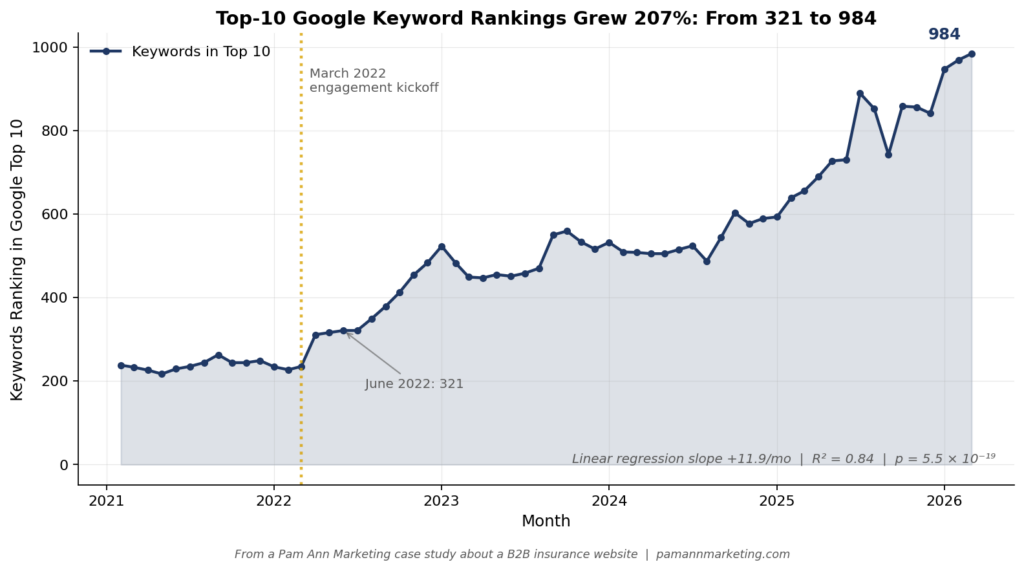
But now, with AI, I can produce incredible first-party research in very little time! Of course, you have to double and triple-check everything that the AI produces for accuracy, but even with that, producing first-party research is more accessible than ever before. Check out this case study that I put together about keyword mapping results: Ongoing SEO Keyword Mapping Leads to 207% Increase in Top-10 Keywords. Even the awesome charts in that case study were made by AI based on the data I gave it!
Stories
Why Add Stories to Your Articles?
In this era of ChatGPT-written articles, you can’t out-produce other websites, but you can out-originate their content. The quality and originality of what you publish matters more than the quantity. It’s better to write one original piece per month than one AI-generated piece per day.
In Google’s announcement from when they added the new “E” (“Experience”) to their E-A-T guidelines, they stated clearly that they want you to demonstrate that you actually experienced something that led to you gaining expertise on your topic:
“Does content also demonstrate that it was produced with some degree of experience, such as with actual use of a product, having actually visited a place or communicating what a person experienced?”6
Ever wonder why Reddit is so often cited in AI-powered search? Reddit posts are often users sharing their experiences and what they learned from them. You need to do this, too, in your article content. And the easiest way is to tell stories.
If you need ideas for how you can apply this concept to your writing, check out the three types of “E” stories I describe in this article under “How to Demonstrate Experiential ‘E'”. If you’re a copywriter generating content on behalf of a brand, consider interviewing subject matter experts (SMEs) using these story ideas. You can also try our Level 3 content planner tool for free at https://contelevate.ai.
By the way, humans love a good story, too. Research has found that “stories were more easily understood and better recalled than essays”7 and that “consumers trust in stories from the involved employee.”8 Storytelling is one of the best ways to earn the trust of your audience and help convert readers to paying clients.
Stories Help Add “Information Gain”
Earlier, I mentioned how Google went from a Level 1 word-matching engine to a Level 2 entity-matching engine. Both Google and AI engines are now at Level 3 sophistication: they can tell when information is original (and therefore citable) and whether or not a piece of content offers “information gain” over what’s already out there.
Google’s patent called “Contextual Estimation of Link Information Gain”9 (filed in 2018 and granted in June 2022) measures how much unique, new data a web page adds compared to what a user has already viewed during a search session. The sophistication of AI now takes this a step further. You need to make sure your content offers measurable information gain over everything else that is published on the internet about the topic.
When you tell a story about an experience that helped you gain expertise, you’re providing invaluable context and information gain that no AI-generated article could ever offer.
Bonus Tip: Update and Repurpose Your Older Content
Although adding fresh new articles on a regular basis is important for the best SEO and AEO/GEO results, it’s equally important to update your older articles as well. You want the search and AI engines to view your website as an up-to-date and thorough encyclopedia on your topic, and to view you as a strong authority on your topic. Both of those require keeping your content up-to-date. Beyond that, older articles probably weren’t created with the “BAKES” method described above, and therefore aren’t fully optimized for modern-day, AI-powered search.
Plus, it’s a lot quicker and easier to update an existing article than to write a new one, so take advantage of that when you’re squeezed for time. It’s better to refresh, rewrite, and relaunch an older article than to publish nothing at all! Just be sure to check Google Search Console to see what keywords are currently driving impressions for that article so that you can retain and enhance your usage of them.
Conclusion
Using the “BAKES” method helps you “bake in” the necessary components for both traditional SEO optimization and modern AEO/GEO optimization of your article content. It’s an easy-to-remember framework that provides measurable results. And thankfully, Google Analytics 4 (GA4) now has a new “AI Assistant” default channel group that can help you watch your AI traffic increase over time as you apply the “BAKES” method of content optimization. It’s now nice and easy to measure the results on your efforts, and if you follow the “BAKES” method, I think you’re going to really like what you see there!
Need Help With SEO or AEO/GEO?
I have been optimizing content for search engines for the last 20+ years, and immediately adapted our agency’s methods for AEO/GEO the moment that LLMs became integrated into search. Our team of senior content optimization experts can help “architect” your content for maximum AI-powered search visibility. Our clients are experiencing high rates of organic search traffic, AI Overview (AIO) visibility, and high conversion rates on the AI engine traffic they’re getting from our AEO/GEO efforts. Contact us today to schedule a consultation.
- https://www.brightedge.com/resources/research-reports/ai-search-visits-in-surging-2025 ↩︎
- https://www.brightedge.com/resources/weekly-ai-search-insights/ai-overviews-one-year-presence-size-citing ↩︎
- https://www.brightedge.com/resources/research-reports/ai-search-visits-in-surging-2025 ↩︎
- https://www.brightedge.com/resources/weekly-ai-search-insights/ai-overviews-one-year-presence-size-citing ↩︎
- https://search.googleblog.com/2012/05/introducing-knowledge-graph-things-not.html ↩︎
- https://developers.google.com/search/blog/2022/12/google-raters-guidelines-e-e-a-t ↩︎
- https://pmc.ncbi.nlm.nih.gov/articles/PMC8219577/ ↩︎
- https://openaccess.city.ac.uk/id/eprint/13881/ ↩︎
- https://patents.google.com/patent/US11354342B2/enSEO ↩︎

- How to Optimize Your Article Content for SEO and GEO/AEO - August 28, 2026
- Why All AI-SEO Studies are Flawed (and What to Trust Instead) - March 12, 2026
- How Much AI-Generated Content is Acceptable for SEO Writing? - February 25, 2026